Supply Chain Control Tower at a Fortune 500 Automotive Manufacturer
KPIs
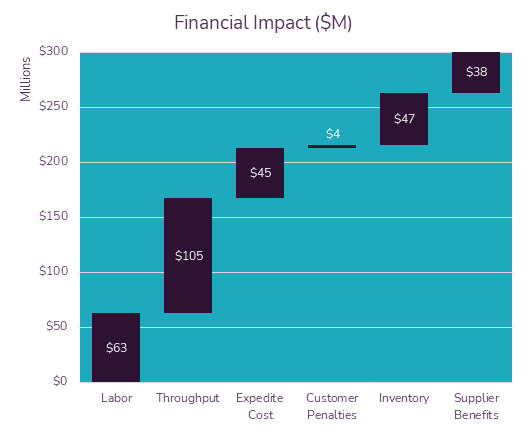
$302M
in Total Benefits
38%
Improvement in On-Time Supplier Shipments
$10M
Reduction in Expedite Costs
23%
Improvement in Team Productivity
Overview
A $10B automotive manufacturing customer faced significant challenges in managing their supply chain due to limited network inventory visibility, restricted to just one or two days. This visibility gap was caused by a reliance on multiple tools, disconnected systems, and disparate data sources, leading to reactive decision-making, suboptimal choices, and increased costs, carbon emissions, and lost revenue. Key metrics impacted include: build schedule adherence, expedites, OTIF, and line downs.
Customer Challenges
The customer faced several critical challenges, including poor visibility into supply and material flow, limited to just one or two days, which hindered proactive decision-making. They also lacked visibility into supplier commitments, such as inventory, capacity, schedules, purchase orders, and forecasts, emphasizing the need for better collaboration and data integration with supply chain partners. This limited visibility reduced their ability to proactively manage and assess risks, impacting overall supply chain resilience and preventing real-time disruption assessments or scenario planning. Furthermore, manual collaboration through spreadsheets, emails, and homegrown tools added inefficiencies, underscoring the need for an integrated, automated platform to improve communication, efficiency, and decision-making across the supply chain.
Scope of Implementation:
860,000 parts
11 facilities
2,500 suppliers
6,000 users
23 systems
185 data sets
Solution
Digital Twin of Customer Enterprise: Built an AI-enabled digital twin of the customer’s business model, processes, partners, data, and systems, enabling real-time visibility into the supply chain, providing a single source of truth for decision-making.
TADA Fabric & Master Data: Connected 23 systems and 185 disparate data sets, delivering the centralized data management needed to integrate supply chain partners and systems seamlessly, enhancing collaboration and real-time decision-making.
Supplier Collaboration Platform: Deployed a collaboration channel with 2,500+ suppliers, providing visibility into demand, supply, inventory, carbon footprint, capacity, and supplier performance metrics, optimizing supplier and partner management through improved collaboration and data-driven insights.
End-to-End Supply Chain Visibility: Enabled comprehensive supply chain visibility, including supplier collaboration, freight visibility, transportation visibility, material coverage, and risk mitigation, ensuring real-time, end-to-end visibility across the supply chain network.
Scenario Planning & Risk Management: Provided the capability for scenario planning, allowing the customer to simulate total cost of ownership (TCO), demand, inventory impact, shipments, and service levels, supporting advanced analytics and scenario modeling for managing disruptions and optimizing operations.
Persona-Based Workbenches: Enabled 8 persona-based workbenches, facilitating enhanced decision-making and improving productivity through role-based dashboards that provide tailored insights to different user groups, ensuring data-driven decision-making.
Connected Data Sets for Real-Time Visibility: Connected 185 data sets to provide real-time visibility into supply chain activities, creating a unified platform that integrates and synchronizes data from various systems, enabling comprehensive visibility and proactive decision-making.
Results
Supply Visibility is reduced from 16+ Weeks to 1-2 Days
Demand Visibility is reduced from 52+ Weeks to 3-4 Weeks
Planner Productivity is reduced from 65 Hours/Week to 15 Minutes
Point of Use Misses are reduced to 90 Units from 1,687 Units
Expedite Costs Improvements is reduced from $28 Million to $13 Million
Inventory ~1.8 Billion had seen a 20+% Reduction in cost
Customer Penalties which are 3% had seen 40% reduction
Conclusion
By implementing Tada’s solution, the customer achieved over $300M in total benefits, including improved supply visibility, enhanced planner productivity, and reduced expedite costs and customer penalties. This solution allowed the customer to optimize their supply chain processes, manage risks, and improve their overall business performance.
Explore more
Multi-Tier Visibility and Collaboration at a Fortune 100 Automotive Manufacturer
View Case Study
Demand Navigator at a $17B Global Steel Manufacturing Leader
View Case Study
Supplier Collaboration Command & Control at a Fortune 500 OEM