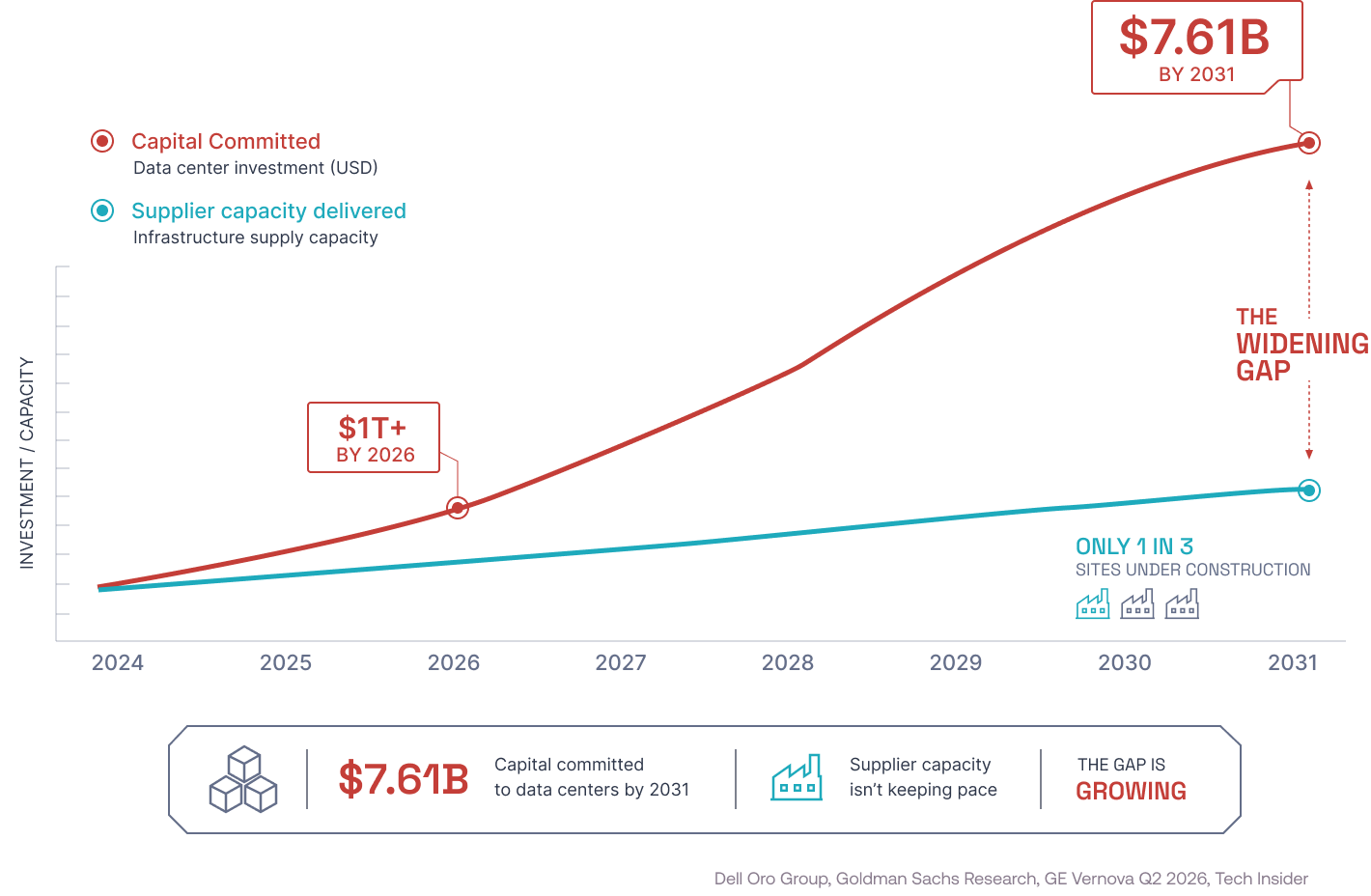
A trillion dollars a year is being committed to physical infrastructure that can't expand at the same rate.
Effective capacity is governed by the tightest constraint across the network,
suppliers, power, labor, logistics, regulation, not by what sits on the balance sheet. Increasingly,
that constraint sits outside the four walls.
A decade of investment fixed one fragmentation. Two are still breaking every response.

The same part, customer, or commitment lives in different systems, on different clocks, with no shared model of how they relate.

Procurement, operations, commercial, and finance each optimize a local objective, with no shared unit of decision.

The same disruption is interpreted differently by every function that sees it, with no shared version of what it means.
Visibility resolved the first fragmentation.
Orchestration requires resolving all three.
Execution and capability are the levers an enterprise can control end-to-end.
Capacity is the lever most exposed to a network it does not control.
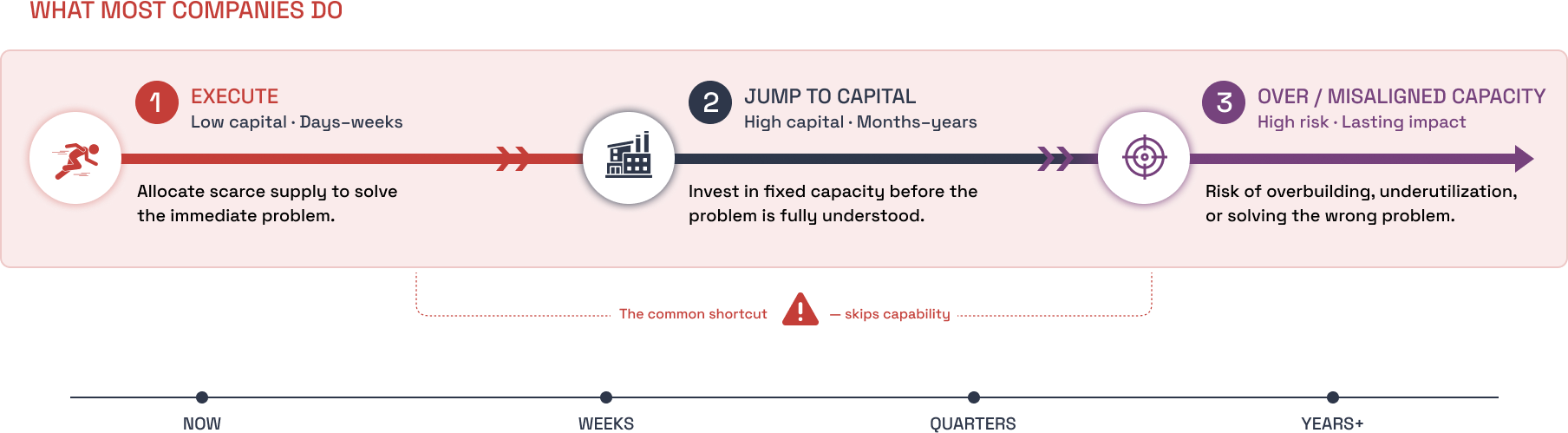
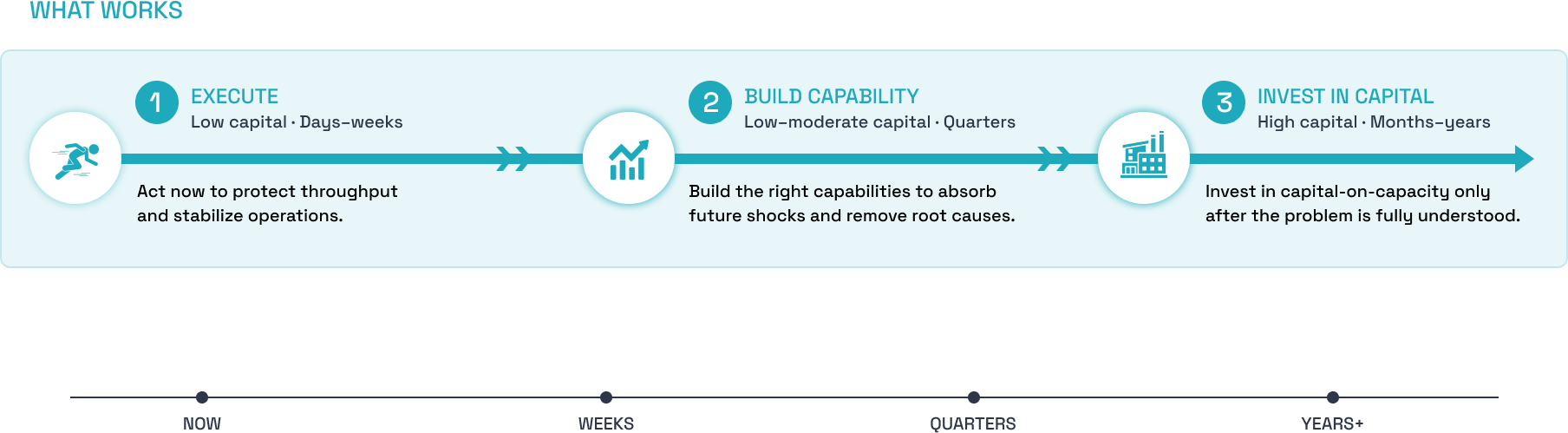
An orchestration model has to be built for this sequence.
Not more theory, this is what TADA delivers. Three command layers, each tied to one of the fragmentations above, put one connected model to work so detecting, deciding, and acting happen as one coordinated motion, not three competing responses.
Senses the constraint the moment it occurs, before it becomes an escalation.
Evaluates the real alternatives against one connected model, not whichever function argues the loudest.
Coordinates the response across every function, at the same moment, off the same facts.
Detect. Decide. Act. Together.
Tap a stage.
This page is the consolidated argument. Each brief below goes further for a specific seat at the table, with the full data and citations behind it.
An illustrative framework: enterprise throughput is bounded by the tightest of six constraint categories, internal capacity, supplier capacity, power and grid access, labor, logistics, and regulatory readiness.
Allocation divides a fixed amount of scarce supply at a single moment. Orchestration senses a constraint, traces its consequence, and coordinates execution across the enterprise.
Data: the same record disconnected across ERP, MES, WMS, and TMS. Operational: every function optimizing a local objective with no shared unit of decision. Cognitive: the same disruption interpreted differently by every function that sees it.
Capacity is slow, capital-intensive, and exposed to constraints outside the enterprise. TADA's Lever Cost-to-Impact Model sequences execution first, capability next, capital last, so capital only follows evidence of where the constraint actually sits.
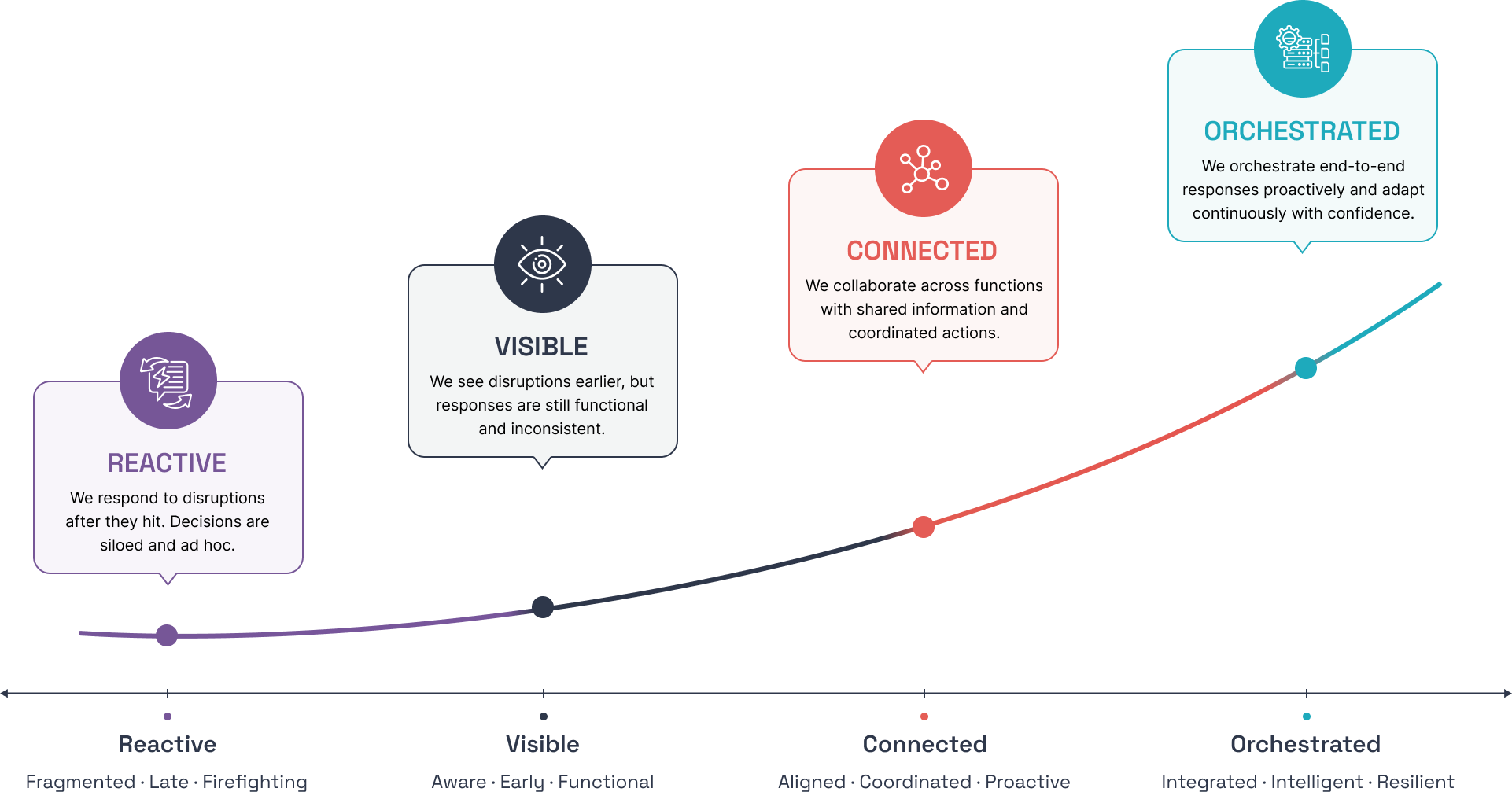
An illustrative framework, not a universal industry benchmark, for judging operating capability across four stages: Reactive, Visible, Connected, and Orchestrated. Each stage resolves progressively more of an enterprise's data, operational, and cognitive fragmentation.
The amplification of small changes in end-customer demand into much larger swings in orders and production further up the chain, driven by forecast updating, order batching, price fluctuations, and shortage gaming. Research finds it occurs in roughly two-thirds of firms and can swing profitability by 10-30%.
Roughly a third of the U.S. data-center capacity targeted for 2026 is under active construction. The rest is delayed or cancelled, largely because physical infrastructure, grid interconnection, transformers, and gas turbines, can't expand as fast as capital is being committed, not because demand is weakening.