Why inventory strategies fail under disruption and how better supply chain coordination enables faster decisions and stronger outcomes.
.jpg)
The inventory has always sat at the center of supply chain performance. But in today’s environment defined by volatility, disruption, and compressed decision cycles, traditional inventory management strategies are no longer enough.
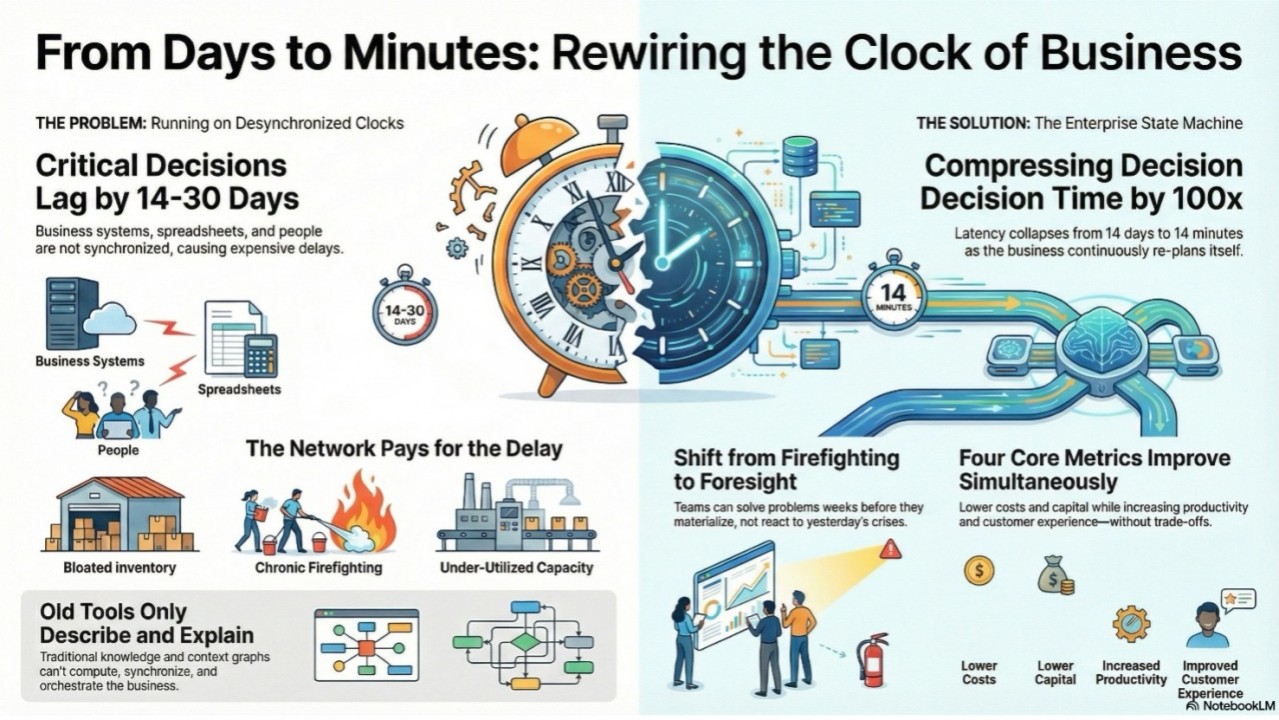
Excess stock and shortages often coexist. Forecasts age quickly. And decisions that once worked in stable conditions now amplify risk when disruption hits. What organizations are discovering is that inventory problems are rarely inventory-only problems. They are coordination problems.
Solving them requires rethinking inventory management strategy alongside how decisions are sensed, evaluated, and executed across the supply chain in other words, adopting a system of action mindset without turning it into another layer of planning.
Why Inventory Management Breaks Down Under Volatility
Most inventory strategies are designed for predictability. They rely on historical patterns, fixed policies, and periodic planning cycles. That works until conditions change faster than plans can be updated.
When volatility increases:
At the same time, data is fragmented across systems and partners, and inventory decisions are made locally by plant, region, or function without full awareness of network-wide impact.
The result is familiar: inventory buffers grow, service levels still suffer, and working capital is tied up in the wrong places. The issue is not a lack of inventory logic, but the absence of a coordinated way to reassess and act as conditions change.
Inventory Management Strategy Is Now a Network Decision
Modern inventory management strategy must move beyond SKU-level optimization and site-specific rules. Inventory is a network asset, and its value depends on where it sits, when it moves, and how quickly it can be repositioned.
Leading organizations treat inventory strategy as:
This shift changes the core question. Instead of asking, “How much inventory should we hold?” teams ask, “Where should inventory be positioned right now to best balance service, cost, and risk?”
Answering that question consistently requires more than better planning it requires a way to continuously sense change, reassess trade-offs, and coordinate execution across the supply chain.
Supply Chain Coordination Is the Missing Link
Inventory decisions rarely fail in isolation. They fail because upstream and downstream actions are not aligned when conditions shift.
When disruption occurs:
Sourcing reacts to constraints, production re-sequences plans, and distribution prioritizes service often without a shared understanding of inventory impact. By the time alignment happens, the opportunity to act has passed.
This is where supply chain coordination becomes critical. Not as a planning exercise, but as an operating capability that keeps inventory, supply, cost, and service decisions connected in real time.
From Static Planning to Continuous Action
Organizations that perform well under volatility do not rely on perfect forecasts. They rely on continuous action loops that connect insight to execution.
In the context of inventory, this means:
This approach doesn’t eliminate uncertainty it absorbs it. Inventory becomes a lever that can be actively adjusted rather than a buffer that passively grows.
Over time, this creates a more adaptive inventory management strategy one that evolves with volatility instead of reacting after the fact.
Coordinating Inventory Across the Value Chain
Effective inventory strategy cannot be separated from the rest of the supply chain. Decisions made in sourcing, production, and distribution all shape inventory outcomes.
A coordinated approach ensures that:
Each function still operates locally, but decisions are made with network-wide awareness. This is how inventory strategy scales from individual sites to the enterprise level.
Turning Inventory into a Strategic Advantage
In volatile environments, inventory will always carry risk. The difference between leaders and laggards is how that risk is managed.
Organizations that align inventory management strategy with coordinated systems of action are able to:
Inventory stops being a symptom of poor coordination and becomes a source of resilience.
From Chaos to Coordination
Volatility isn’t going away. Forecasts will continue to break under disruption. And inventory will remain one of the most expensive and powerful levers in the supply chain.
The path forward is not more static planning, but better coordination through continuous action. By rethinking inventory management strategy as part of a broader, connected operating model, organizations can move from reactive firefighting to deliberate, coordinated execution. That is how chaos gives way to coordination and how inventory becomes a strategic asset, not a liability.
Test your own scenarios with TADA’s Clean TO! Build and see the impact in minutes.
Try TADA Clean TO! Build
Test your own scenarios with TADA’s RM Inventory Manager and see the impact in minutes.
Try RM Inventory Manager

Use TADA’s Tariff Manager to model costs, build agility, and protect margins.
Try the Tariff Manager
Test your own scenarios with TADA’s Tariff Manager and see the impact in minutes.
Try the Tariff Managerest your own scenarios with TADA’s RM Inventory! Manager and see the impact in minutes.
TRY RM Inventory! Manager
Team TADA brings together supply chain practitioners, data engineers, and AI specialists focused on turning complex supply chain data into coordinated action. TADA-an anagram for Data-is built on an AI-enabled Digital Twin foundation that connects data, processes, partners, and decisions to enable real-time visibility, actionable insights, and scenario-based planning across extended supply chain networks.TADA supports mission-critical operations for complex supply chains across manufacturing, CPG, retail, and healthcare. With more than 50 enterprise deployments over the past four years, the team has worked with both Fortune 100 organizations and mid-market companies to modernize how supply chains are planned, monitored, and executed.

.jpg)
.jpg)